April 15, 2026
The hidden health effects of the air around you
Poor air quality can worsen asthma and affect daily life. We support programs that help people manage symptoms and make informed choices.
The environment can shape health in ways we don’t always see. Community conditions play an important role in supporting long-term well-being.
Clean air plays a powerful role in health, especially for people with asthma and other respiratory conditions.
When air quality is poor, breathing can become harder and symptoms can get worse.
At Kaiser Permanente, we do a lot to protect the environment and improve air quality.
We also support programs that help people deal with unhealthy air. One provides at-home asthma support. Another provides local air quality data in real time.
These efforts give people clear information and practical ways to protect their lungs.
At-home asthma support program
When Maria Maia Davis, a Kaiser Permanente member, received an email about a program to help manage asthma at home, she signed up right away.
Maia Davis has asthma, as does her 9-year-old grandson who lives with her.
I learned a lot of things I never thought about that can be causing our asthma. It’s been a real education for us. Maia Davis
Both are now part of a program we created with the Central California Asthma Collaborative.
Community health workers visit her home and check in with her by phone. They help the family spot asthma triggers, use medications correctly, and reduce exposure to things that can make symptoms worse.
Those triggers include heat, pollen, and diesel smoke outside, as well as dust, cooking smoke, pets, and cleaning products inside.
During the visits, Maia Davis and her grandson received air purifiers, a HEPA vacuum, mattress covers, and inhaler spacers.
“I learned a lot of things I never thought about that can be causing our asthma,” she said. “It’s been a real education for us.”
Community air quality information program
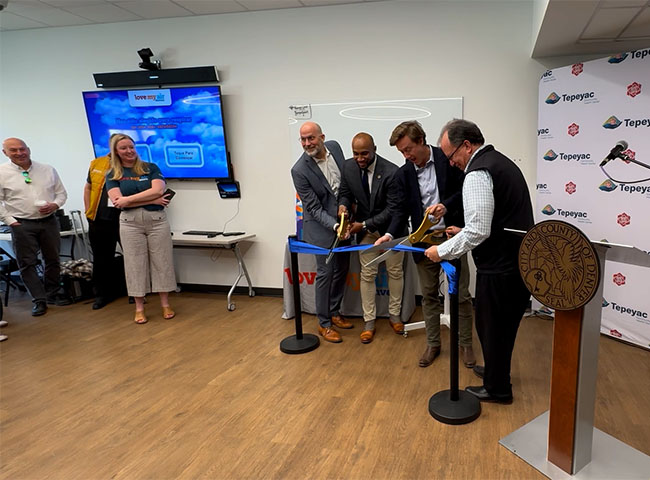
In Denver and Adams County, Colorado, we help fund Love My Air, a program that shares real-time information about indoor and outdoor air quality.
People can use kiosks at medical facilities and other public locations to check local air conditions. There is also an app they can use on their phones. They can then use that information to plan their day.
Air quality monitors and kiosks are available at the Kaiser Permanente East Denver Medical Offices, Tepeyac Community Health Center, and Inner City Health.
More than 4,000 people have used the program. Many of them receive care in neighborhoods that have the worst air quality and other kinds of pollution that affect health.
“If patients have access to this information, they can make informed decisions that help preserve their health,” said Chris Fellenz, MD, director of safety-net partnerships for Kaiser Permanente in Colorado.
Research shows that people are more likely to use air quality information when it comes from trusted health care sources.
Turning air quality data into action
These efforts share a simple idea: Health care does not stop at the exam room door.
Kaiser Permanente is now exploring ways to share real-time air quality alerts directly with Kaiser Permanente members, potentially in partnership with programs like Love My Air.
Helping people breathe easier takes more than medicine. It means reaching people where they live, learn, and spend their time.