Our impact
Our impact
As the country’s largest private nonprofit health care organization, providing care for 12.9 million Americans, Kaiser Permanente is a leading voice with health care policy decision-makers. We believe it is important to provide our perspective on complex policy debates and engage the public in these critical issues.
Choose a location to learn about our impact there.

Our impact nationally
Founded in 1945, Kaiser Permanente headquartered in Oakland, California, comprises:
- Kaiser Foundation Health Plan, Inc.
- Kaiser Foundation Hospitals and its subsidiaries
- The Permanente Medical Groups

Members1
12.9M

Employees2
225,854

Nurses3
78,630

Physicians4
25,270

Medical offices5
610

Hospitals
40
Local markets
- Denver
- Boulder
- Colorado Springs
- Fort Collins
- Greeley
- Loveland
- Pueblo
- Atlanta
- Athens
- Kauai
- Hawaii
- Maui
- Oahu
- Baltimore
- Washington, D.C.
- Northern Virginia
- Suburban Maryland
- Reno–Sparks metro area
- Central Valley
- Diablo
- East Bay
- Fresno
- Golden Gate
- Greater Sacramento
- Greater Southern Alameda County
- Napa-Solano
- San Mateo
- Santa Rosa
- South Bay
- Portland, Ore.
- Eugene, Ore.
- Salem, Ore.
- Vancouver, Wash.
- Longview/Kelso, Wash.
- Coachella Valley
- Kern County
- Inland Empire
- Metro Los Angeles/West Los Angeles
- Orange County
- San Diego County
- Tri-Central Area
- West Ventura/Valleys
- Northwest Washington
- Central Washington
- Eastern Washington
- Coastal and Olympic Region
- Puget Sound
1 Data as of June 30, 2026, unless otherwise noted.
2 Employee data approximate as of June 30, 2026, representing technical, administrative, and clerical employees, nurses, and non physician caregivers.
3 Nurse data approximate as of December 31, 2025, representing all specialties.
4Approximate as of December 31, 2025, representing all specialties; excluding pool, network, and referral physicians as well as locum tenens.
5 Medical offices and other outpatient facilities as of 10 a.m. on June 30, 2026.
Data as of June 30, 2026, unless otherwise noted. Please note this information does not include Risant Health and its affiliates. For more information visit risanthealth.org.

Our impact in California
Kaiser Permanente was founded in California in 1945. Today, we provide care and coverage to 12.9 million members, including over 9.6 million Californians.
Our award-winning way of providing health care makes sure that doctors, hospitals, and other health services like pharmacies work closely together.
This teamwork helps keep patients healthy and offers them care when they need it. It also makes things easier and more convenient for our members — and keeps costs down. Our approach is part of why we’re one of the top health care organizations in California, with many top-rated hospitals.
Kaiser Permanente is the largest private employer in the state. We have:
19,105
Physicians1
183,938
Employees2

150,4003
Union members3
Diversity and inclusion are important to us. We’re proud to be recognized as one of the Best Places to Work for Disability Inclusion and an LGBTQ+ Healthcare Equality Leader.
As a nonprofit, we do more than just provide high-quality health care services. Our mission motivates us to improve the health of our members and the communities we serve.
We use our resources and work with our partners to make our communities healthier and fairer for everyone. In 2024, we committed $2.9 billion to improve the lives of Californians across the state.
Key issues in California
We’re dedicated to a future in which every Californian has access to high-quality health coverage. Already, 94% of Californians have some form of health coverage. We’re focused on bridging the gap to achieve 100% coverage, also known as universal coverage.
We support expanding health coverage to all Californians by building on what works, like strengthening Covered California, making Medi-Cal available to more people, and tackling things that make health care expensive, such as the cost of prescription drugs.
Our work toward universal coverage also includes an agreement with the state to expand our geographic presence in Medi-Cal and the number of enrollees we serve
We’re making mental health and addiction treatment more accessible for everyone in California.
Since 2020, we’ve spent over $1.1 billion to improve our mental health services.
We hired nearly 600 new therapists and expanded our network to include more community therapists.
We will continue to grow and diversify our mental health workforce. We’ll also continue to promote policies that ensure people have access to high-quality mental health and addiction care that is safe, timely, effective, equitable, and patient-centered.
We’ve also invested $195 million in new clinics, with 329 new offices for mental health professionals.
We’re concerned about the high cost of prescription drugs and how it affects our members.
We provide safe, effective medication at a good value by:
- Using the most current, evidence-based research to choose the drugs we cover
- Negotiating prices
- Using generic and biosimilar drugs
- Keeping track of safety and outcomes
As a health plan, provider, and pharmacy in one, we have a diverse perspective on the prescription drug marketplace. This informs and shapes our approach to public policy, with a clear focus on making prescription medications safer, more effective, and more affordable for everyone.
Helping our members and communities thrive is core to our mission. It’s part of everything we do — from promoting equity in education and the workplace to working toward ending systemic racism to supporting policies aimed at preventing youth vaping.
Join us in shaping a healthier future for California. At Kaiser Permanente, our dedicated care, comprehensive services, and community partnerships are designed to empower our members and strengthen communities. Together, we can achieve lasting health and wellness across the state.
1 Approximate as of December 31, 2025, representing all specialties; excluding pool, network, and referral physicians as well as locum tenens.
2 Employee data approximate as of June 30, 2026, representing technical, administrative, and clerical employees, nurses, and non physician caregivers.
3 As of June 30, 2026.
Our impact in California
Kaiser Permanente was founded in California in 1945. Today, we provide care and coverage to 12.9 million members, including over 9.6 million Californians.
Our award-winning way of providing health care makes sure that doctors, hospitals, and other health services like pharmacies work closely together.
This teamwork helps keep patients healthy and offers them care when they need it. It also makes things easier and more convenient for our members — and keeps costs down. Our approach is part of why we’re one of the top health care organizations in California, with many top-rated hospitals.
Kaiser Permanente is the largest private employer in the state. We have:
19,105
Physicians1
183,938
Employees2
130,500
Union members3
Diversity and inclusion are important to us. We’re proud to be recognized as one of the Best Places to Work for Disability Inclusion and an LGBTQ+ Healthcare Equality Leader.
As a nonprofit, we do more than just provide high-quality health care services. Our mission motivates us to improve the health of our members and the communities we serve.
We use our resources and work with our partners to make our communities healthier and fairer for everyone. In 2024, we committed $2.9 billion to improve the lives of Californians across the state.
Key issues in California
We’re dedicated to a future in which every Californian has access to high-quality health coverage. Already, 94% of Californians have some form of health coverage. We’re focused on bridging the gap to achieve 100% coverage, also known as universal coverage.
We support expanding health coverage to all Californians by building on what works, like strengthening Covered California, making Medi-Cal available to more people, and tackling things that make health care expensive, such as the cost of prescription drugs.
Our work toward universal coverage also includes an agreement with the state to expand our geographic presence in Medi-Cal and the number of enrollees we serve
We’re making mental health and addiction treatment more accessible for everyone in California.
Since 2020, we’ve spent over $1.1 billion to improve our mental health services.
We hired nearly 600 new therapists and expanded our network to include more community therapists.
We will continue to grow and diversify our mental health workforce. We’ll also continue to promote policies that ensure people have access to high-quality mental health and addiction care that is safe, timely, effective, equitable, and patient-centered.
We’ve also invested $195 million in new clinics, with 329 new offices for mental health professionals.
We’re concerned about the high cost of prescription drugs and how it affects our members.
We provide safe, effective medication at a good value by:
- Using the most current, evidence-based research to choose the drugs we cover
- Negotiating prices
- Using generic and biosimilar drugs
- Keeping track of safety and outcomes
As a health plan, provider, and pharmacy in one, we have a diverse perspective on the prescription drug marketplace. This informs and shapes our approach to public policy, with a clear focus on making prescription medications safer, more effective, and more affordable for everyone.
Helping our members and communities thrive is core to our mission. It’s part of everything we do — from promoting equity in education and the workplace to working toward ending systemic racism to supporting policies aimed at preventing youth vaping.
Join us in shaping a healthier future for California. At Kaiser Permanente, our dedicated care, comprehensive services, and community partnerships are designed to empower our members and strengthen communities. Together, we can achieve lasting health and wellness across the state.
1 Approximate as of December 31, 2025, representing all specialties; excluding pool, network, and referral physicians as well as locum tenens.
2 Employee data approximate as of June 30, 2026, representing technical, administrative, and clerical employees, nurses, and non physician caregivers.
3 as of [DATE]

Our impact in Colorado
Kaiser Permanente has provided care and coverage to Colorado residents since 1969. We’re proud to be one of Colorado’s largest health care providers and a leading nonprofit health plan.
Across the region, we have approximately 502,410 members, 34 medical offices, and a network of partner hospitals.
Our 6,522 physicians and employees in Colorado focus on improving the health of our members and communities in the Denver, Boulder, Fort Collins, Colorado Springs, and Pueblo areas.
Our history — and our future — are deeply connected to organized labor. More than 60% of our health care professionals in Colorado are union members. We work closely with the Service Employees International Union and the United Food and Commercial Workers International Union. Together, we work to make high-quality health care more accessible and affordable for everyone.
Key issues in Colorado
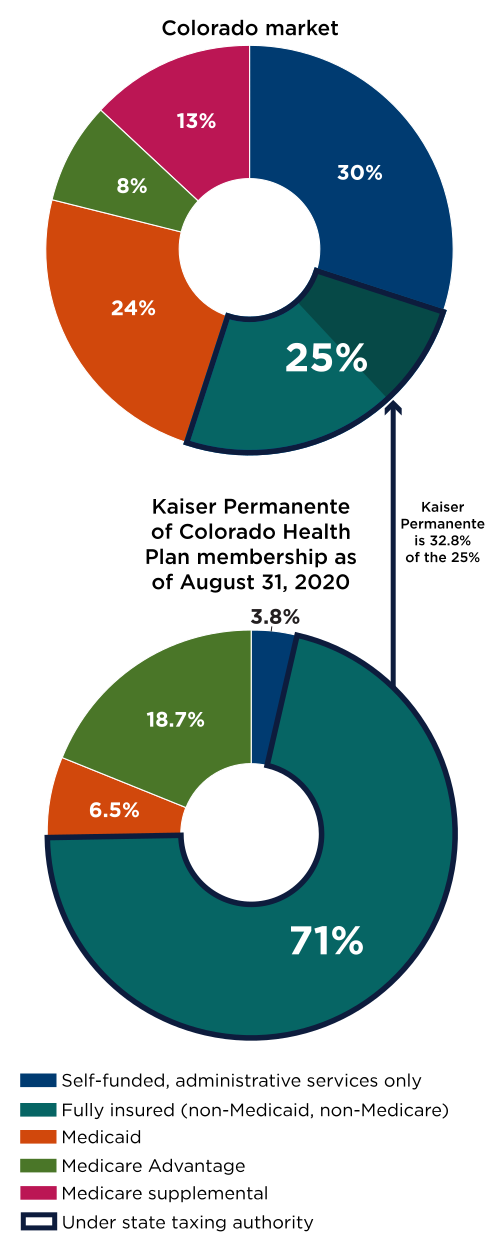
Most Americans receive health care coverage through their employer. Employers generally choose between 2 ways of funding when they sponsor a health plan on behalf of their workforce: self-funded or fully insured.
Self-funded plans are an agreement in which the employer (or labor trust) directly takes on the financial risk of paying for their employees’ medical claims as they occur. With fully insured health plans, the employer purchases an insurance or coverage product through an insurer or coverage provider, such as Kaiser Permanente. The health insurer or coverage provider takes on the risk for the cost of covered care.
Self-funded plans are generally not subject to state regulations and requirements. As the largest provider of fully insured plans in Colorado, Kaiser Permanente has a much higher proportion of plans subject to state regulatory authority and state taxes and fees compared to other carriers in the state.
| Self-funded | Fully insured | |
|---|---|---|
| Payments | The employer does not pay premiums; instead, it pays fixed costs (administrative fees and stop-loss premiums) and variable costs (employee health care claims). | The employer pays monthly premiums to an insurance carrier or coverage provider. |
| Assumption of risk | The employer assumes the risk. | The health plan or insurance company assumes the risk. |
| Compliance payments | The Employee Retirement Income Security Act of 1974 generally preempts state regulations and taxation. | The plan must comply with state regulations and taxation. |
| Regulatory authority | The federal government regulates. | The state and federal governments regulate. |
Note: Market size according to Decision Resources Group as of January 2020, including individuals with dual Medicare and Medicaid coverage. Data for Colorado (statewide).
| Colorado Market | |
|---|---|
| Coverage | Percentage |
| Self-funded, administrative services only | 30 |
| Fully insured, under state taxing authority | 25 |
| Medicaid | 24 |
| Medicare Advantage | 8 |
| Medicare supplemental | 13 |
Kaiser Permanente is 32.8% of the 25% of the fully insured market.
| Kaiser Permanente of Colorado Health Plan membership as of August 31, 2020 | |
|---|---|
| Coverage | Percentage |
| Self-funded, administrative services only | 3.8 |
| Fully insured, under state taxing authority | 71 |
| Medicaid | 6.5 |
| Medicare Advantage | 18.7 |
Tobacco is a leading cause of preventable death and disease in Colorado. Every year, Coloradans pay $2.9 billion for smoking-related health care costs.
Reducing tobacco use is critical to improving the health of our communities. This is why we advocate for policies that prevent people from starting to use tobacco products and help people who are already addicted quit.
In 2022, Kaiser Permanente strongly supported a Colorado House bill, HB22-1064, that would have banned the sale of flavored tobacco and nicotine products, including menthol cigarettes, across the state.
The legislation ultimately failed, but we’ll continue supporting laws that ban flavored tobacco products.
Flavors make tobacco products seem less harsh. And flavored products appeal to young people. Our goal is to give all young people a chance to grow up free from nicotine addiction.
We’re concerned about the burden high drug prices impose on our members and society.
We provide our members with safe, high-quality medications at a strong value for their dollar. We do this by:
- Prescribing based on evidence
- Negotiating drug prices
- Using generics and biosimilars
- Tracking safety and outcomes
As a health plan, provider, and pharmacy in one, we have a diverse perspective on the prescription drug marketplace. Our experience informs an array of policy positions designed to make prescription drugs more effective, safer, and more affordable.
Our impact
In 2024, we provided $110 million to support the health of Colorado communities. That amount includes the cost of providing charitable care and coverage.
- Grants and donations: We distributed $5.6 million to community organizations across Colorado, supporting housing, food security, schools, and workforce development.
- Charitable coverage and care: We dedicated $23.5 million to ensure access for uninsured and underinsured Coloradans, alongside $69.5 million invested in Medicaid and other government programs.
- Support for rural clinics: In 2024, we partnered with the Colorado Rural Health Center to strengthen care in underserved areas, supporting 16 rural clinics to improve staffing and expand access to essential services. We also provided grant funding to the Colorado Community Health Network to enhance workforce sustainability among clinical support staff, helping community health centers continue delivering care to underserved populations statewide.
- Food Is Medicine: We contributed $650,000 to food and nutrition initiatives, supporting 8 community partners. Together, we helped 71,000 people access critical food and nutrition resources.
- Mental Health Workforce Accelerator: In 2024, we invested $4.2 million to strengthen Colorado’s behavioral health workforce. The program supported 56 licensure candidates, who together served more than 5,100 clients, helping expand access to mental health care across the state.
- Housing for Health: In 2024, we supported medical respite care programs for people experiencing homelessness. This included Ascending to Health Respite Care in Colorado Springs, which hired 7 new staff and served 147 people; RecoveryWorks in Lakewood, which helped 110 people with emergency services and housing support; and the Colorado Coalition for the Homeless, which expanded services by hiring a licensed practical nurse to care for more than 2,100 patients.
- Thriving Schools: In 2024, we awarded $275,000 to the Chef Ann Foundation to expand scratch-cooked meals, and $1.5 million to the Public Education & Business Coalition to strengthen teacher retention and diversity. Thriving Schools resources were used by 19 districts and charter schools statewide.
Our care
- Quality and service: Kaiser Permanente offers highly rated commercial health plans and the highest-rated Medicare health plan in Colorado, according to NCQA 2025 rankings.
- Medicare Advantage: U.S. News and World Report named Kaiser Permanente of Colorado to its 2026 Best Insurance Companies for Medicare Advantage list.
Our people
Top doctors: Each year, 5280 magazine asks more than 7,500 Denver area doctors which doctors they’d trust to treat themselves and their families. In 2025, a record 355 Kaiser Permanente doctors were named Top Doctors by 5280. Kaiser Permanente also has the most top doctors in 23 medical specialty areas.
Strengthening Colorado together
Join us in shaping a healthier future for Colorado. At Kaiser Permanente, our dedicated care, comprehensive services, and community partnerships are designed to empower our members and strengthen communities. Together, we can achieve lasting health and wellness across the state.

Our impact in Georgia
Kaiser Permanente is a pioneer in coordinated health care and coverage. And we’re the largest nonprofit health plan in Georgia.
Our health care professionals provide services to 449,604 members in the state. We cover a wide area, including 32 counties in the metropolitan Atlanta and Athens regions.
At Kaiser Permanente, we focus on the total health of our members. Our doctors, specialists, and other health care professionals lead our members’ care. All our 643 physicians and 3,173 employees work to improve the health of our members and communities.
Key issues in Georgia
We provide our members with safe, high-quality medications at a good value for their dollar. We do this by using evidence-based prescribing, negotiating drug prices, using generics and biosimilars, and tracking safety and outcomes.
We support policies that:
- Address the types of anticompetitive practices that prevent lower-priced generic drugs from entering the market
- Curb arbitrary drug price increases
- Promote the use of evidence-based practices
- Support the creation of a fair system that assesses and pays for drugs according to their value
Policymakers in Georgia are considering new proposals concerning pharmacy benefit managers. We firmly oppose proposals that do not account for our unique care and coverage model.
As a health plan, care organization, and pharmacy in one, Kaiser Permanente is not a pharmacy benefit manager. Our integrated approach to pharmacy benefits and operation means:
- We only provide services to our members. Kaiser Permanente does not provide any pharmacy-related services to any health care consumer outside of our integrated care model.
- Our pharmacies do not submit drug reimbursement claims to our own health plans, since both are part of the same integrated entity.
- Our integrated structure enables us to keep drug costs down for our members.
Proposals that fail to consider our integrated model could force a costly restructuring of our pharmacy practices. This would harm our members by increasing costs without producing any benefits.
Our communities are experiencing unprecedented levels of anxiety, depression, and related conditions. At Kaiser Permanente, we believe the mind can’t be treated separately from the body. So, we consider mental health in our total health approach.
We support mental health policies that:
- Reinvent outdated models of care
- Support and rebuild a stressed and strained workforce
- Invest in preventive services and evidence-based care innovations
By 2034, the country expects a shortfall of up to 124,000 physicians. The United States needs over 200,000 new nurses annually through 2031 to meet demand. Additionally, by 2026, the country will need 3.2 million other health care roles.
The high cost and daunting time commitment required for health care education complicates these staffing challenges.
In response to this challenge, we believe:
- Policymakers at the state and federal levels should expand funding for training programs, tuition assistance, and loan forgiveness programs.
- Congress has a critical role to play in helping to grow and diversify the workforce — specifically around increasing federal funding for clinical training programs and physician residency slots.
Our impact
Kaiser Permanente’s impact extends beyond our facilities and into the communities we serve.
Through Educational Theatre, Medicaid involvement, and programs like the Bridge Program and Medical Financial Assistance, we offer a range of services and support. These initiatives are designed to empower, educate, and provide essential health care access to people in need.
Learn more about our ongoing programs and investments.
Care that sets the bar
- Our commercial and Medicare health plans in Georgia received 4-star and 4.5-star ratings, respectively, in the National Committee for Quality Assurance’s 2024 annual report.
- In 2023, our health plans received number-one ratings in 51 of 125 HEDIS® (Healthcare Effectiveness Data and Information Set) effectiveness-of-care measures, covering key areas like cancer screenings, blood pressure management, diabetes care, behavioral health, and timely prenatal and postpartum care.
Recognized for diabetes prevention
The Centers for Disease Control and Prevention awarded full recognition to our diabetes prevention program. This achievement acknowledges the program’s active role in helping people reduce their risk of type 2 diabetes through practical lifestyle education.
Strengthening Georgia together
Join us in shaping a healthier future for Georgia. At Kaiser Permanente, our dedicated care, comprehensive services, and community partnerships are designed to empower our members and strengthen communities. Together, we can achieve lasting health and wellness across the state.

Our impact in Hawaii
Kaiser Permanente has served Hawaii since 1958. We currently provide care to 275,915 members throughout the state. We’re the state’s second-largest health plan.
We offer a wide variety of coverage options for small group, large group, and individual and family health insurance markets.
We serve our members using a unique business model that combines health coverage and care delivery into one coordinated experience.
Key issues in Hawaii
Tobacco is a leading cause of preventable death and disease in Hawaii. Every year, Hawaii residents pay over $500 million for smoking-related health care costs.
Reducing tobacco use is critical to improving the health of our communities. This is why we advocate for policies that prevent people from starting to use tobacco products and help people already addicted quit.
Banning the sale of flavored tobacco is particularly important. Flavors make tobacco products seem less harsh and appeal to young people. We continue to support removing all flavored tobacco products from the market, including products used with electronic cigarettes.
In 2023 and 2024, the city and county of Honolulu and Hawaii County passed flavored tobacco bans.
We commend their efforts. However, these bans can’t be enforced because the state of Hawaii controls tobacco regulation. The state took over this authority in 2018 and has yet to pass its own ban.
By banning flavored tobacco, we can give all young people a chance to grow up free from nicotine addiction.
By 2034, the U.S. expects a shortfall of up to 124,000 physicians.
The U.S. also faces a shortage of nurses and other health care workers. The country needs over 200,000 new nurses annually through 2031 to meet demand. And, it needs 3.2 million other health care workers — including medical assistants, home health aides, and nursing assistants — by 2026.
Hawaii has a shortage of 4,000 health care workers.
Key reasons for the shortages are the high cost — and the daunting time commitment — of health care education.
To address staffing shortages, we believe:
- Policymakers at the state and federal levels should expand funding for training programs, tuition assistance, and loan forgiveness programs
- Congress has a critical role to play in helping to grow and diversify the workforce — specifically around increasing federal funding for clinical training programs and physician residency slots
We are working to grow our workforce.
In Hawaii, programs like our Mental Health Workforce Accelerator address the critical shortage of licensed mental health professionals.
This program helps aspiring mental health professionals get supervised work experience. It also offers financial incentives, training, peer support, and coaching to help participants overcome licensure barriers. We offer this program in partnership with the University of Hawaii’s Thompson School of Social Work & Public Health and the National Council for Mental Wellbeing.
We also help students explore health care careers through the Summer Youth Employment Program. This paid internship gives high school and college students hands-on experience and builds a strong local workforce for the future.
The Diagnostic Imaging Summer Experience Program is an 8-week paid program that gives students hands-on experience with imaging tools like X-ray machines, CT scanners, ultrasound units, and MRI systems. Students also earn college credit and gain essential skills for future health care jobs. We offer this program in collaboration with the University of Hawaii Maui College and the Hawaii/Pacific Basin Area Health Education Center.
We’re concerned about the burden high drug prices impose on our members and society.
We provide our members with safe, high-quality medications at a strong value for their dollar. We do this by:
- Prescribing based on evidence
- Negotiating drug prices
- Using generics and biosimilars
- Tracking safety and outcomes
As a health plan, provider, and pharmacy in one, we have a diverse perspective on the prescription drug marketplace. Our experience informs an array of policy positions designed to make prescription drugs more effective, safer, and more affordable.
Our impact
Our goal is to champion good health in Hawaii — for our members and everyone who lives and works there.
Through partnerships with community groups, schools, and government organizations, we work to improve access to health care, influence public policies, and develop programs that promote healthy living.
Learn about how we’re investing in communities across Hawaii.
Our care
Kaiser Permanente’s model combines care and coverage. Our approach allows us to provide coordinated care that supports total health.
Our model ensures our members receive high-quality care, leading to better outcomes. This is why we have the highest-ranked Medicare and Medicaid health plans in the state according to the National Committee on Quality Assurance.

Top doctors
293 world-class Kaiser Permanente doctors were named Top Doctors and Rising Stars by Castle Connolly in 2025.

Best hospitals
Our Moanalua Medical Center received the 2025 Women’s Choice Award® as one of America’s best hospitals for cancer care, obstetrics, and stroke care.

Best in maternity
Our Moanalua Medical Center earned a spot on Newsweek’s 2025 Best Maternity Hospitals list for excellence in maternity care.

Highly rated Medicare plans
Our Medicare health plan consistently receives high ratings for quality. For 2025, the plan received 4.5 out of 5 stars for quality from the National Committee for Quality Assurance.
Strengthening Hawaii together
Join us in shaping a healthier future for Hawaii.
At Kaiser Permanente, our dedicated care, comprehensive services, and community partnerships are designed to empower our members and strengthen communities.
Together, we can achieve lasting health and wellness across the state.

Our impact in Maryland, Virginia, Washington, D.C.
Kaiser Permanente is the leading nonprofit health care organization in the mid-Atlantic states (Northern Virginia; metropolitan Washington, D.C.; and metropolitan Baltimore).
We serve our 744,330 members with 41 medical facilities, 14 urgent care centers, and a network of affiliated hospitals.
Key issues in Maryland, Virginia, Washington, D.C.
Our communities are experiencing unprecedented levels of anxiety, depression, and related conditions. At Kaiser Permanente, we believe the mind can’t be treated separately from the body and so we consider mental health in our total health approach.
- Help reinvent outdated models of care
- Support and rebuild a stressed and strained workforce
- Invest in preventive services and evidence-based care innovations
We’re concerned about the burden high drug prices impose on our members and society.
We provide safe, effective medication at a good value by:
- Using the most current, evidence-based research to choose the drugs we cover
- Negotiating prices
- Using generic and biosimilar drugs
- Keeping track of safety and outcomes
As a health plan, provider, and pharmacy in one, we have a diverse perspective on the prescription drug marketplace. Our experience informs an array of policy positions designed to make prescription drugs more effective, safer, and more affordable.
We’re dedicated to a future in which everyone in the United States has access to high-quality health coverage. This is called universal coverage, and we believe it’s within reach.
In Maryland, we helped create the country’s first easy-enrollment insurance sign-up program. Marylanders can now enroll in Medicaid or other insurance by just ticking a box on their state tax form. In 2021, we supported legislation that created a similar program in Virginia.
We also supported efforts in Maryland to expand Medicaid coverage to include:
- Adult dental services
- Coverage for pregnant immigrants who lack permanent legal status and their children up to age 1
We also support efforts to help more young adults in Maryland sign up for health coverage.
In 2022, young adults ages 18 to 37 became eligible for extra discounts through the Young Adult Premium Assistance program. Before, the program helped adults only up to age 34. This change increased young adult enrollment by about 11% between 2022 and 2023.
In Virginia, we supported the creation of a reinsurance program to help bring down costs of individual premiums. The Virginia program aims to reduce premiums by 15% annually and has reduced the uninsured rate.
By 2034, the country expects a shortfall of up to 124,000 physicians. The United States needs over 200,000 new nurses annually through 2031 to meet demand. Additionally, by 2026, the country will need 3.2 million other health care roles.
The high cost and daunting time commitment required for health care education complicates these staffing challenges.
In response to this challenge, we believe:
- Policymakers at the state and federal levels should expand funding for training programs, tuition assistance, and loan forgiveness programs
- Congress has a critical role to play in helping to grow and diversify the workforce — specifically around increasing federal funding for clinical training programs and physician residency slots
Our impact
In 2024, we invested more than $343 million to support the health and well-being of people in Virginia, Maryland, and Washington, D.C., including $109 million in charitable coverage and care.
Our investment also provided $2.3 million in grants, sponsorships, and donations to various community groups. These funds supported initiatives that increase access to health care as well as initiatives to address social health — having the basic needs for a healthy life. For example, the funds supported ensuring people had access to economic opportunities, housing, education, and enough food to eat.
Our care
Top-rated private health plan: Kaiser Permanente of the Mid-Atlantic States stands out among the nearly 1,000 health plans rated across the country. It’s 1 of only 8 commercial health plans nationwide to earn a top score of 5 out of 5 stars in the 2025 National Committee for Quality Assurance’s health plan ratings report. It is also the only commercial health plan in Virginia, Maryland, and Washington, D.C., to achieve this top score.
Top-rated Medicare and Medicaid plans: Kaiser Permanente of the Mid-Atlantic States received 4.5 stars out of 5 in the 2025 NCQA health plan ratings report for its Medicaid plan in Maryland and for its Medicare plans in Virginia, Maryland, and Washington, D.C.
Our people
Top-rated doctors: More than 500 of our physicians in Virginia, Maryland, and Washington, D.C., are on “top doctors” lists in publications such as Arlington Magazine, Bethesda Magazine, Northern Virginia Magazine, and Washingtonian magazine.
Strengthening the mid-Atlantic together
Join us in shaping a healthier future for Virginia, Maryland, and the District of Columbia. At Kaiser Permanente, our dedicated care, comprehensive services, and community partnerships are designed to empower our members and strengthen communities. Together, we can achieve lasting health and wellness across the mid-Atlantic.

Our impact in Oregon and Southwest Washington
Since 1945, Kaiser Permanente has delivered care and coverage in the Pacific Northwest.
Currently, we care for 606,232 medical and 284,320 dental members in Oregon and Southwest Washington.
Our long-standing presence and membership base has established us as one of the largest private employers in the region.
Key issues in Oregon and Southwest Washington
People in our communities are experiencing unprecedented levels of anxiety, depression, and related conditions. At Kaiser Permanente, we believe the mind can’t be treated separately from the body. So, we consider mental health in our total health approach.
We support mental health policies that:
- Reinvent outdated models of care
- Support and rebuild a stressed and strained workforce
- Invest in preventive services and evidence-based care innovations
We’re concerned about the burden high drug prices impose on our members and society.
We provide our members with safe, high-quality medications at a strong value for their dollar. We do this by:
- Prescribing based on evidence
- Negotiating drug prices with manufacturers
- Using generics and biosimilars when available
- Tracking safety and outcomes
As a health plan, provider, and pharmacy in one, we have a unique perspective on the prescription drug marketplace. Our experience informs an array of policy positions designed to make prescription drugs more effective, safer, and more affordable.
By 2034, the country expects a shortfall of up to 124,000 physicians. The United States needs over 200,000 new nurses annually through 2031 to meet demand. Additionally, by 2026, the country will need 3.2 million more professionals in other health care roles.
The high cost and time commitment required for a health care education complicates the workforce shortage, as does the recruitment of health care educators due to low salaries compared to workforce wages.
In response to this challenge, we believe:
Policymakers at the state and federal levels should expand funding for training programs, tuition assistance, and loan forgiveness programs
Congress has a critical role to play in helping grow and diversify the workforce — specifically increasing federal funding for clinical training programs and physician residency slots
Tobacco is a leading cause of preventable death and disease in Oregon and Washington state. Every year, residents of both states pay over $4.8 billion for smoking-related health care costs.
Reducing tobacco use is critical to improving the health of our communities. This is why we advocate for policies that prevent people from starting to use tobacco products and help people who are already addicted quit.
Read about some of our work to reduce tobacco use in Oregon.
- Supporting increased tobacco taxes — Taxing electronic cigarettes and tobacco products is a proven approach to reducing smoking and vaping. Taxing slows the rate of new users, which saves lives and reduces costs to the health care system.
In 2020, Kaiser Permanente strongly supported Oregon Measure 108, which proposed a tobacco tax increase.
The measure passed, increasing taxes on cigarettes and cigars, and creating a new tax on electronic cigarettes. Most of the additional tax revenues are supporting the Oregon Health Authority in paying for the treatment of sick people, especially people with mental illnesses. Working to ban the sale of flavored tobacco — Flavors make tobacco products seem less harsh and often make them appeal to young people. We continue to support removing all flavored tobacco products from the market, including products used with electronic cigarettes.
We’re a leading sponsor of the Flavors Hook Oregon Kids coalition. The coalition is working to end the sale of flavored tobacco in Oregon.
As a result of our and the coalition’s ongoing advocacy, the 2 largest counties in Oregon have passed ordinances ending the sale of flavored tobacco. We are striving to protect those wins and introduce more bans across the state.
Our impact
Kaiser Permanente’s presence throughout Oregon and Southwest Washington has a positive impact on communities.
Through our care, hospitals, medical and dental buildings, and community investments, we are a major contributor to the local economy. Our contributions include:
- Investing just over $240 million in charitable care, community health initiatives, and engagement in 2024. These investments focused on several key areas including access to care, stronger cities, community engagement, volunteerism, economic opportunity, environmental stewardship, housing, mental health, nutrition security, oral health, public health, racial equity, subsidized care and coverage, social health, and healthy schools.
- Operating 2 hospitals, 50 medical offices, and 20 dental offices
- Employing 1,383 physicians, 140 dentists, and 12,053 employees in the Northwest
Our care
Kaiser Permanente’s model combines care and coverage. Our approach allows us to provide coordinated care that supports total health.
Our model ensures our members receive high-quality care, leading to better outcomes. This is why we are among the highest-ranked health plans in the state.

Best hospital maternity care
Kaiser Permanente Sunnyside and Westside medical centers were each named a Best Hospital for Maternity Care by U.S. News and World Report for 2025 based on quality measures such as rates of cesarean section in lower-risk pregnancies, newborn complication rates, exclusive breast milk feeding rates, early elective delivery rates, birthing-friendly practices, and transparency on racial and ethnic disparities.

Top heart program
Our Sunnyside Medical Center in Clackamas, Oregon, is the only hospital in Oregon and Washington named by Healthgrades as one of America’s 50 Best for Cardiac Surgery for 10 years in a row (2015 to 2024).

Care excellence
All our primary care medical offices have earned top-level tier 4 certification from the Oregon Health Authority. This means we meet the highest standards for providing personalized, coordinated, accessible care to our patients.

Highest rated health plans
For the seventh consecutive ratings cycle, Kaiser Permanente Northwest’s commercial and Medicare plans are rated highest or tied for highest among our competitors.
- Our commercial medical health plan is rated highest among 19 commercial plans in Oregon and Washington, according to the National Committee for Quality Assurance’s 2025 ratings.
- Our Medicare health plan tied for highest among 27 Medicare plans rated by NCQA in Oregon and Southwest Washington.
Highest rated health plans
For the seventh consecutive ratings cycle, Kaiser Permanente Northwest’s commercial and Medicare plans are rated highest or tied for highest among our competitors.
- Our commercial medical health plan is rated highest among 19 commercial plans in Oregon and Washington, according to the National Committee for Quality Assurance’s 2025 ratings.
- Our Medicare health plan tied for highest among 27 Medicare plans rated by NCQA in Oregon and Southwest Washington.
Strengthening Oregon and Southwest Washington together
We encourage all policymakers to join us in shaping a healthier future for Oregon and Washington.
At Kaiser Permanente, our dedicated care, comprehensive services, and community partnerships are designed to empower our members and strengthen communities.
Together, we can achieve lasting health and wellness across the state.

Our impact in Washington
Kaiser Permanente cares for 562,812 members in Washington. Our skilled teams include 973 physicians and 1,490 nurses. They’re supported by clinical and nonclinical staff.
With 31 medical offices, we serve many areas — including Puget Sound; Northwest, Central, and Eastern Washington; and the Coastal and Olympic areas.
More than 62% of our health care workers are in a union. We value our relationships with the Service Employees International Union, the United Food and Commercial Workers International Union, and the Office and Professional Employees International Union.
Each union plays an important role in our efforts to attract highly qualified people and provide high-quality, affordable care.
Key issues in Washington
We support policies that promote health, prevent diseases, and improve the quality of health care. Our integrated care and coverage model is designed specifically to achieve these goals, delivering better health outcomes for our members and setting us apart from traditional health care systems.
Our model offers:
- Care coordination: We make sure all parts of a patient’s care work together. This means doctors and other clinicians talk to each other and plan care. This helps patients get the right care for their needs.
- Evidence-based care: We use the latest research to guide our care. This helps make sure patients get proven treatments that work.
- Smart data usage: Our robust electronic health record system allows us to use data to improve care. We gather anonymous patient information to find out what works and what doesn’t.
- Affordability: Our model puts patients first. We make sure all parts of the organization work together to provide high-quality care and keep costs low. We are different from many other health care organizations because we’re membership-based and prepaid. This means we focus on keeping people healthy, not making money when they get sick. Our doctors are paid a salary and follow proven methods. This helps them provide better care and leads to better health for our members.
Our communities are facing high levels of anxiety, depression, and related issues.
We believe that health care must consider all aspects of a person — their mind, body, and spirit. That’s why we include mental health as a part of our total health approach.
- Help reinvent outdated models of care
- Support and rebuild a stressed and strained workforce
- Invest in preventive services and evidence-based care innovations
We provide our members safe, high-quality medications at a good value for their dollar. We do this by using evidence-based prescribing, negotiating drug prices, using generics and biosimilars, and tracking safety and outcomes.
We support policies that:
- Address the anticompetitive practices that prevent lower-priced generic drugs from entering the market
- Curb drug price increases that don’t have a clear justification
- Promote the practice of prescribing based on evidence
- Support the creation of a fair system that assesses and pays for drugs according to their value
- Create a more competitive market for biologic drugs
Reducing tobacco use is critical to improving the health of our communities. This is why we advocate for policies that prevent people from starting to use tobacco products and help people addicted to quit.
Banning the sale of flavored tobacco is particularly important, and we’re a proud partner of Flavors Hook Kids Washington.
Flavors make tobacco products seem less harsh and appeal to young people. We support removing all flavored tobacco products from the market, including products used with electronic cigarettes.
Health coverage by plan type
Note: The percentages are according to 2023 data from the state of Washington’s Office of the Insurance Commissioner.
| Coverage | Percentage |
|---|---|
| Self-funded | 29.5 |
| Fully insured | 14.6 |
| Medicaid | 25.9 |
| Medicare | 18.9 |
| Uninsured | 4.7 |
Market structure
Most Americans receive health care coverage through their employer. Employers generally choose between 2 methods of funding when they sponsor a health plan on behalf of their workforce: self-funded or fully insured.
Self-funded plans are an agreement in which the employer (or labor trust) directly takes on the financial risk of paying for its employees’ medical claims as they occur. With fully insured health plans, the employer purchases an insurance product through an insurance carrier or health plan, such as Kaiser Permanente, and the insurer or plan takes on the risk for the cost of covered care.
Self-funded plans are generally not subject to state regulations and requirements. As the largest provider of fully-insured plans in Washington state, Kaiser Permanente has a much higher proportion of plans subject to state regulatory authority and state taxes and fees compared to other carriers in the state.
Our impact
We’re advancing health equity in Washington communities. This means we’re working to give all people an equal chance for a healthy life. And we’re addressing social and economic factors that can contribute to health.
Our approach includes:
- Creating healthy environments
- Increasing economic and educational opportunities
- Ensuring everyone can get affordable, healthy food
- Adding options for safe physical activities
We help people get the food they need.
Since 2020, we’ve given over $3 million to food assistance programs in Washington. These programs helped more than 319,000 kids and families get the food they need. Our support also helps schools give free meals.
Now, more than 206,000 students in Washington get free breakfast and lunch at school.
We gave $1.78 million from 2022 to 2025. This money will help schools work with community groups led by people of color. These groups run food programs that help over 16,000 kids and families in need.
Getting needed health care continues to be challenging for many Washingtonians, including young people.
School-based health centers provide convenient, high-quality care for students. These centers may also offer services for staff and community members.
We operate 8 school-based health centers in partnership with King County Public Health. We also provided key investments to start and build 8 additional school-based health centers across the state.
We support programs and funding in Washington to start, build, expand, and evaluate these important programs.


